


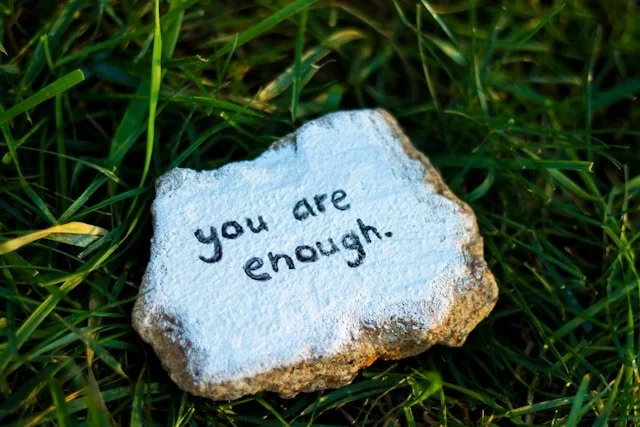
The reality behind our culture’s favorite mantra: Matthew McCullough begins, “I don’t know where it came from, but now it seems to be everywhere. I hear it on podcasts and TV shows. I’ve seen it on T-shirts and social media graphics. A quick search for it on Amazon brings up hundreds of results, ranging from books for kids and adults to silver charm bracelets to hoodies of many colors to embroidered makeup cases to wall hangings and throw pillows and stickers to place on your rearview mirror. I’m talking about the simple, uplifting mantra for our times: ‘You Are Enough.’”

This Week's Recommendations
When peace feels impossible: Christopher Cook says, “As such, when Paul says “do not be anxious,” he is not instructing believers to numb their emotions, detach from their circumstances, or pretend life doesn’t hurt. He’s inviting us to recalibrate the affections of our hearts. And that recalibration begins with a theological claim far deeper than a surface-level command. It begins with presence.”
When waiting draws us near: Bethany Broderick says, “Our world seems allergic to waiting. We pay hundreds of dollars for faster shipping
This Week's Recommendations
Sex, virtue, technology: Marc Sims with an important article on the impact of technology on sexuality, “Imagine a world of thorns and thistles and serpents and porn and affairs and divorce. (Shouldn’t be too hard for you). It is a world that has attempted to peel sex out of the context of covenant and commitment—even out of relationship itself—and pursue the physical pleasure as an end of itself.”
Stay put and make disciples: David Mathis begins, “This is a plea for aging Christians not to follow millions of your peers in making a tragic mistake: leaving the place, and especially the local church, where you have built up years, if not decades, of relational capital.”
This Week's Recommendations
When bitterness becomes your religion, healing becomes heresy: Christopher Cook says, “But here’s the fruit of that belief system: the most anxious, entitled, bitter, and emotionally fragile generation in history. The world is not freer. It is more fractured. The culture of curated authenticity has not led us to peace, but to exhaustion.”
Mortifying our desire: Keith Evans begins, “A young man once told me, “I never chose to feel this way. These attractions seem to have always been part of my life.” His honesty captures what so many experience—same-sex attraction often feels unchosen, even natural. But when we look to Scripture, we discover even that which may feel natural is not always good.”
This Week's Recommendations
Are we the idols? Andrew Noble says, “It is strange to become an idol, isn’t it? It’s hard to wrap your mind around. Yet every day, people are morphing into something like mud. Instead of functioning as images of God, they worship idols and turn into lifeless dust. Life goes wrong when we don’t worship right.”
Weakness in God’s economy: Kirsten shares, “As I consider my heart, my struggle does not come in whether or not I believe that God is able to heal; I believe that God is able to do all that pleases him. Rather, my struggle comes in believing whether or not God is willing; at least in the timeframe I am hoping and praying.”
This Week's Recommendations
Some therapists aren’t telling you the truth: Christopher Cook begins, “Somewhere along the way, a cadre of therapists stopped telling people the truth. What began as a space for self-examination, emotional healing, and forward movement has slowly morphed into a mirror, one that reflects dysfunction and calls it authenticity.”
School choice participation up 25%: Adam Wittenberg reports that, “These gains mark a seismic shift in how America educates its children.”
This Week's Recommendations
When safety becomes a god: Christopher Cook warns, “We’re living in a cultural moment where safety has been enthroned as the highest virtue. You hear it everywhere: “I need to feel safe here.” “I need to feel seen.” “I need to feel welcome.” On the surface, these phrases sound kind. Compassionate, even. But beneath the sentimental polish, there’s often an unspoken expectation: ‘Don’t challenge me.’”
A biblical pathway to emotional wisdom: Dan Brewer says, “Our emotions are not a flaw in God’s design. They are not a curse either—they are a gift.
This Week's Recommendations
The wilderness was never meant to last forever: Christopher Cook says, “The wilderness was never meant to be your home. For many of us, however, it has become one (a dysfunctionally comfortable one at that). Not because God’s promises changed, and not because your story was disqualified, but rather, because somewhere along the way, you might have stopped listening to the voice of the Lord and trusting His nature and His ways.”
The great friendship collapse: In this video, Derek Thompson explains why we spend more time than ever and what the impact that has had on us.
This Week's Recommendations
Will I ever love a church again? Brittany Allen asks, “Could I reclaim that vulnerability that once came so naturally to me after it had been used as a weapon pointed at my own heart? Could God rebuild my faith in his Bride and redeem what had been lost?”
The hidden curriculum of the wilderness: Christopher Cook says, “When you’re in that space—the wilderness between who you were and who you’re becoming—you will be tempted to mislabel it; to call it punishment; to rebuke it like it’s an attack; even, to distract yourself from it.
This Week's Recommendations
Four good questions to ask your tech: Tim Challies says, “We are in constant communication with our devices and through our devices. And since we are already in the habit of asking them our deep and personal questions, perhaps it would do us good to ask them some good and honest questions about themselves. Here are four questions I propose we ask of any technology that has become (or has the potential to become) deeply embedded in our lives.”
Embracing the silence: Christopher Cook says, “We’re spiritually exhausted, disoriented, and desperate to hear from God. And in our desperation, we turn up the volume, hoping that more input will lead to more clarity. But the Lord doesn’t compete with the chaos. His voice doesn’t cut through the noise. It waits for stillness.”


