With a new year comes new resolutions: aspirations for improvement. If you could add just one discipline to your life, which one would make the most impact? Diet? Exercise? Meditation?
The answer might be reading the Bible.
If you think about, it’s not surprising that God’s Word is so transformative in our lives. Do you remember the first novel you cried when you read? Do you remember reading a book that changed the way you think about life? I have a distinct memory from seventh grade. A frayed paperback copy of John Steinbeck’s Of Mice and Men shook in my hands as I wept over the final scene with George and Lennie. God’s Word is not a dry textbook of facts about God. David says, “Oh, taste and see that the Lord is good! Blessed is the man who takes refuge in him!” (Ps. 34:8). Scripture invites us to experience God.
Reading the Bible is not merely a discipline of growing in knowledge. As we interact with God’s Word, we are transformed. The author of Hebrews tells us that, “For the word of God is living and active, sharper than any two-edged sword, piercing to the division of soul and of spirit, of joints and of marrow, and discerning the thoughts and intentions of the heart” (Heb. 4:12). God echoes this in Jeremiah, “Is not my word like fire, declares the Lord, and like a hammer that breaks the rock in pieces?” (Jer. 23:29).
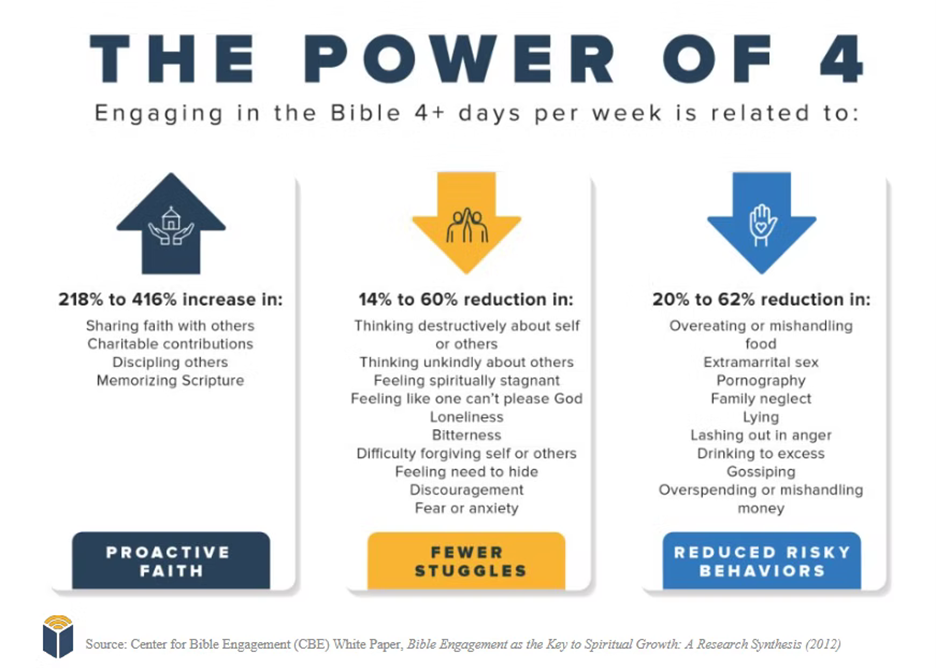
The Center for Bible Engagement surveyed more than 100,000 about their spiritual lives and found some startling evidence about the impact of time in the Word.
The survey found that:
· Engaging Scripture most days of the week produces a more proactive faith among Christians. Controlling for age, gender, church attendance, and prayer practices, individuals engaged in the Bible have significantly higher odds of giving financially, memorizing Scripture, and sharing their faith with others.
· People’s perceptions of their own spiritual growth are also impacted by how often they hear from God through the Bible. Those who engage Scripture most days of the week are less likely to feel spiritually stagnant and to feel that they can’t please God.
· Receiving, reflecting on, and responding to God’s Word four or more times a week decreases a person’s odds of struggling with select issues, such as feeling bitter, thinking destructively about self or others, having difficulty forgiving others, and feeling discouraged.
· A person who engages the Bible four or more times a week is much less likely to give into certain temptations, such as drinking to excess, viewing pornography, lashing out in anger, gossiping, and lying.
God’s Word is closely connected to God’s Spirit. Peter tells us that our new birth is connected to the word of God: “[S]ince you have been born again, not of perishable seed but of imperishable, through the living and abiding word of God; for
“All flesh is like grass
and all its glory like the flower of grass.
The grass withers,
and the flower falls,
but the word of the Lord remains forever.”
And this word is the good news that was preached to you” (1 Pet 1:23-25).
The Word is connected to our spiritual rebirth as well as our sanctification.
Finally, God’s Word demonstrates his character. We are perpetually tempted as human beings to project our expectations upon God. In his Word, God gently corrects our misperceptions. At Mt. Sinai, God passes before Moses and declares of himself, “The Lord passed before him and proclaimed, “The Lord, the Lord, a God merciful and gracious, slow to anger, and abounding in steadfast love and faithfulness, keeping steadfast love for thousands, forgiving iniquity and transgression and sin, but who will by no means clear the guilty, visiting the iniquity of the fathers on the children and the children's children, to the third and the fourth generation” (Ex. 34:6-7). Moses appropriately responds: bowing and worshiping God. We meet God in his Word and as we encounter him we are invited to worship him in “spirit and in truth” (Jn. 4:24).
Do you want to be transformed in 2026? Do you want to experience the power of God’s Spirit? Do you want to know God’s heart? I sure do! Let’s make 2026 a year of daily encountering God in His Word.
You may also appreciate:
Do You Submit to the Bible, or Does the Bible Submit to You?
Photo by Tim Mossholder on Unsplash